
Home / Face / Facelift
FACELIFT IN DALLAS
A natural-looking facelift with board-certified plastic surgeon Dr. Fadi Constantine, co-author of published research on the lift-and-fill facelift. Your face lifted and refreshed, never stretched or pulled.
A facelift is surgery that lifts the sagging deeper tissue of the lower face and jawline, then redrapes the skin and trims the excess without pulling it tight. It treats jowls, deep folds between the nose and mouth, and loose skin along the jaw and upper neck. Done well, it makes you look rested and younger, not “done.” Most patients are back to normal social life in about two weeks.
On this page: Photos · Lift and fill · Types of facelift · Facelift vs. neck lift · Recovery · Cost · FAQ
Facelift Before and After Photos
These are real patients of Dr. Constantine, photographed before surgery and after healing. Everyone’s face ages differently and results vary, so look for patients whose starting point is closest to yours, and bring the ones you like to your consultation.

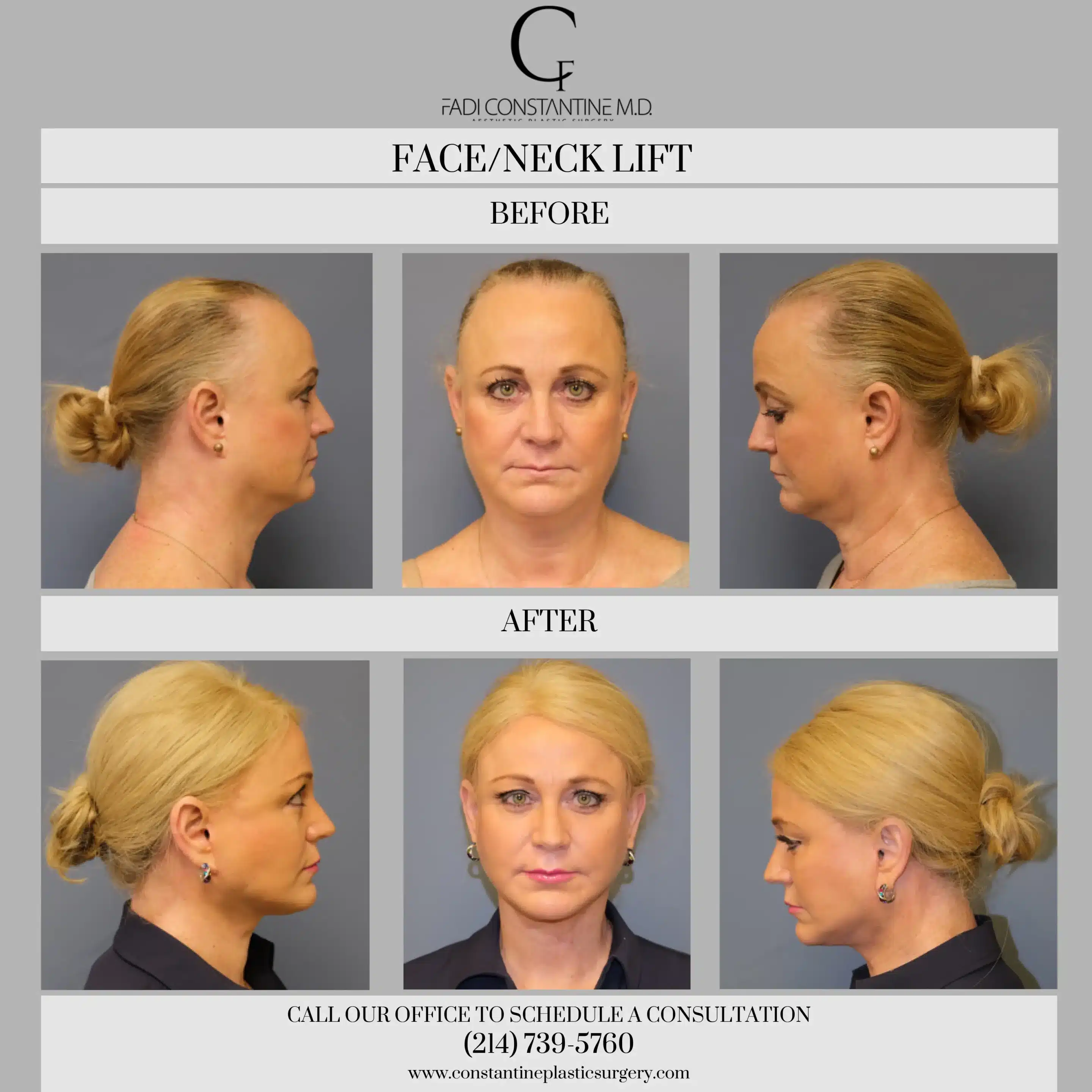
What Does a Facelift Do?
Three things happen to the face with age, all at once. The skin loosens. The deeper support layer under it, called the SMAS, slides down and forward, which is what creates jowls and softens the jawline. And the small pads of fat that keep a young face full start to shrink and drop, so the cheeks flatten and hollows appear.
A facelift fixes the first two. Dr. Constantine lifts the SMAS back to a higher position and secures it there, then redrapes the skin over it and removes only what’s left over. Because the deeper layer carries the lift, the skin isn’t stretched tight. That’s the difference between a natural facelift and the windswept look people worry about.
A facelift can improve:
- Jowls and a blurred or uneven jawline
- Deep folds between the nose and mouth (nasolabial folds) and lines running down from the corners of the mouth (marionette lines)
- Loose skin and bands along the jaw and upper neck, especially when combined with a neck lift
- A flat, deflated midface, when combined with fat grafting
On its own, a facelift doesn’t change drooping brows, heavy upper eyelids, under-eye bags, or fine wrinkles and sun damage on the skin’s surface. Those are treated with a brow lift, eyelid surgery or skin treatments, and Dr. Constantine will tell you honestly whether adding one is worth it.
Dr. Constantine’s Approach: The Lift-and-Fill Facelift
Older facelifts focused on pulling tissue up. The problem is that aging isn’t only sagging. It’s also lost volume, and lifting alone can leave a face that looks tight but still tired, or thin and hollow.
Dr. Constantine co-authored a paper on exactly this: “Lift-and-Fill Face Lift: Integrating the Fat Compartments”, published in Plastic and Reconstructive Surgery in 2014 with Dr. Rod Rohrich and colleagues at UT Southwestern. The idea is to treat both sides of facial aging in one operation. The sagging deeper tissue gets lifted, and volume is restored with your own fat where the face has deflated, usually the cheeks, under the eyes and around the mouth.
The two work better together than either does alone. The lift corrects the sag, the fat brings back the soft fullness of a younger face, and the result looks like you on a good day rather than a different person. Learn more about facial fat transfer.
“My approach to facelifts is to treat every patient as an individual. Everyone has different things they want to achieve with their procedure, which is why I sit down with every patient and find out exactly what their desires are.” Dr. Fadi Constantine
Types of Facelift: SMAS, Deep Plane, Mini and More
You’ll see a lot of facelift names online. Most of them describe two things: how deep the surgeon works, and how much of the face and neck gets treated. Here’s what the common ones mean.
SMAS Facelift
An SMAS facelift lifts and tightens the deeper layer of muscle and connective tissue, then redrapes the skin over it. It’s the foundation of most modern facelifts, and the lift-and-fill technique builds on it by adding fat grafting where volume has been lost.
Deep Plane Facelift
A deep plane facelift releases the SMAS along with the small ligaments that anchor it, so the skin and deeper layer move up together as one unit. Some surgeons favor it for heavy jowls and deep folds. The name gets a lot of attention, but no single technique is right for every face. What matters most is that the deeper tissue is lifted well, lost volume is restored, and the skin isn’t under tension. Ask Dr. Constantine which approach suits your anatomy, and why.
Mini Facelift
A mini facelift uses shorter incisions and mainly treats early jowling along the lower face. Recovery is quicker, but it does little for the neck and won’t hold up as well when there’s a lot of loose tissue. It tends to suit younger patients with mild changes and good skin.
Facelift with Neck Lift
Most people bothered by their jowls also have some loose skin, fat or banding in the neck. That’s why a facelift is so often combined with a neck lift, done through the same incisions plus a small one under the chin, for a smooth line from cheek to collarbone.
Mid Face Lift
A mid face lift targets the cheeks and the area under the eyes rather than the jawline. It can be done on its own or alongside a lower facelift.
| Mini facelift | Facelift (SMAS, lift and fill) | Facelift with neck lift | |
|---|---|---|---|
| Best for | Early jowling, good skin | Jowls, folds and volume loss in the lower and mid face | Jowls plus loose skin, fat or bands in the neck |
| Incisions | Shorter, around the ear | In front of and behind the ear, into the hairline | Same, plus a small one under the chin |
| Treats the neck | Very little | Upper neck and jawline | Yes, full neck |
| Typical time before going out in public | About 1 week | About 2 weeks | About 2 to 3 weeks |
Facelift vs. Neck Lift: Which Do You Need?
The two treat neighboring areas, and they’re done together more often than not. A facelift works on the cheeks, jowls and jawline. A neck lift works on the area under the chin and down the neck: loose skin, fullness from fat, and the vertical muscle bands that show up with age.
A quick way to think about it. If the jawline is your main concern, start with a facelift. If it’s mostly a heavy or loose neck with a fairly crisp jaw, a neck lift alone may do it. If both bother you, combining them gives one smooth result and one recovery. And if the only issue is a small pocket of fat under the chin with good skin, liposuction or Kybella may be enough. Learn more about neck lift surgery.
Are You a Good Candidate for a Facelift?
You’re likely a good candidate if you:
- Are bothered by jowls, deep folds around the mouth, or loose skin along your jaw and neck
- Are in good general health, with conditions like high blood pressure or diabetes under control
- Don’t smoke or vape, or are willing to stop for several weeks before and after surgery, since nicotine slows skin healing
- Are at a fairly stable weight
- Want to look refreshed rather than like a different person, and understand what surgery can and can’t change
There’s no ideal age. Some people in their 40s have early jowls, and plenty of healthy patients in their 70s do very well. What matters is how much sagging you have, the quality of your skin and your overall health.
Your Facelift Consultation
Your consultation is where the plan takes shape. Expect it to cover:
- What bothers you, in your own words. Many patients bring an old photo from 10 or 15 years ago.
- Your health history, including any blood thinners, supplements or past facial procedures.
- An exam of your skin, bone structure, fat and how far the tissue has descended.
- A recommended plan: the technique, and whether a neck lift, fat grafting, brow lift or eyelid surgery should be added.
- Before and after photos of patients with a similar starting point.
- A written quote and your financing options.
There’s no pressure to book on the day. Many patients go home, think it over, and call back with more questions.
Facelift Surgery and Recovery
Most facelifts are done under general anesthesia and take a few hours, longer when a neck lift, fat grafting or other procedures are added. Many patients go home the same day with someone to care for them, and some stay overnight.
Here’s what a typical recovery looks like. Your own timeline may be a little faster or slower.
| When | What to expect |
|---|---|
| First 2 to 3 days | Rest with your head raised. Swelling and bruising peak. Discomfort is usually mild to moderate and managed with medication. A dressing, and sometimes small drains, may be in place briefly. |
| About 1 week | Most stitches come out. Bruising starts to fade. Short, easy walks are encouraged. |
| About 2 weeks | Most patients feel comfortable out in public and back at desk work. Makeup can cover what’s left of the bruising. |
| 3 to 4 weeks | Back to exercise and more strenuous activity once Dr. Constantine clears you. |
| 3 to 6 months | Remaining swelling and numbness settle, and the face looks natural and relaxed. |
| Up to a year | Scars keep softening and fading. |
Facelift Scars
Every facelift leaves scars, so where they go matters. Dr. Constantine places incisions in the natural crease in front of the ear, tucks them behind the ear, and carries them into or along the hairline, plus a short one under the chin when the neck is treated. Because the deeper layer carries the lift, the skin closes without tension, which helps scars heal fine and flat. They’re usually pink for the first few months and fade over about a year.
Risks to Know About
All surgery carries some risk. With a facelift the main ones are bleeding under the skin (hematoma), infection, slow wound healing, visible scarring, temporary numbness, changes to the hairline near incisions, and asymmetry. Rarely, a branch of a facial nerve is injured, causing weakness that is usually temporary. Smoking and high blood pressure raise the risk of complications, so you’ll get clear instructions before surgery to lower it. Dr. Constantine goes through all of this in detail at your consultation.
How Long Does a Facelift Last?
A facelift turns the clock back, but it doesn’t stop it. Your face keeps aging from its new starting point, so years later you’ll typically still look younger than you would have without surgery. For many people the result holds up well for about 10 years, and longer with sun protection, good skin care, a stable weight and not smoking. Restoring volume with fat also helps the result age naturally, because a fuller face tends to look younger longer than a lifted but hollow one.
How Much Does a Facelift Cost in Dallas?
There’s no single facelift price, because no two plans are the same. A mini facelift and a full facelift with neck lift and fat grafting are very different operations. Your cost depends on:
- The technique and how much of the face and neck is treated
- Whether you add a neck lift, fat grafting, brow lift or eyelid surgery
- How long surgery takes
- Anesthesia and surgical facility fees
- Whether you need an overnight stay
- Medications and follow-up visits
You’ll get a written quote after your consultation, once Dr. Constantine knows exactly what your plan involves. Many patients spread the cost with financing. A cosmetic facelift isn’t covered by insurance.
Why Patients Choose Dr. Constantine for Facelift Surgery
Dr. Fadi Constantine is a board-certified plastic surgeon in Dallas and a member of The Aesthetic Society. He trained at UT Southwestern Medical Center and Manhattan Eye, Ear & Throat Hospital, and his published research covers facial aging and rhinoplasty, including the lift-and-fill facelift paper above.
He performs your surgery himself, plans every incision with care, and aims for results that look natural rather than “operated.” He also does a large amount of delicate reconstructive work, and brings that same attention to tissue handling and healing to cosmetic surgery of the face. Meet Dr. Constantine
Facelift FAQ
What is the best age for a facelift?
There’s no single right age. Most facelift patients are in their 40s to 70s, but what matters is how much sagging you have along the jaw and neck, your skin quality and your general health. Some people with early changes are better served by a smaller procedure or fillers first.
How long does a facelift last?
A facelift doesn’t stop aging, but it resets the starting point. For many people the result holds up well for about 10 years, and longer with sun protection, a stable weight and not smoking.
How long is facelift recovery?
Most patients feel comfortable going out in public and returning to desk work after about two weeks. Strenuous exercise usually waits three to four weeks. Most swelling settles over three to six months.
Will my facelift look natural?
It should. Dr. Constantine lifts the deeper SMAS layer rather than pulling the skin tight, and restores lost volume with fat grafting when it’s needed. That combination avoids the stretched, windswept look of older techniques.
What is the difference between a facelift and a neck lift?
A facelift treats the lower face: jowls, the jawline and folds around the mouth. A neck lift treats loose skin, fat and muscle bands under the chin and down the neck. Many patients have both, done through the same incisions in one surgery.
Is a deep plane facelift better than a SMAS facelift?
Not automatically. A deep plane facelift releases the deeper layer and its ligaments so skin and SMAS move together, and some surgeons prefer it for heavy jowls. No single technique is best for every face. Dr. Constantine will explain which approach suits your anatomy and why.
What is a mini facelift?
A mini facelift uses shorter incisions to treat early jowling in the lower face. Recovery is quicker, but it does little for the neck and suits people with mild sagging and good skin.
Can fat grafting be done with a facelift?
Yes. Dr. Constantine co-authored published research on the lift-and-fill facelift, which combines lifting with fat grafting to restore volume in the cheeks and around the eyes and mouth. Many of his facelift patients have both.
Will I have visible scars after a facelift?
All facelifts leave scars, but they’re placed in the natural crease in front of the ear, behind the ear and in or along the hairline, plus a small one under the chin if the neck is treated. Most fade to fine lines over about a year.
How much does a facelift cost in Dallas?
It depends on the technique, whether you add a neck lift, fat grafting or other procedures, and anesthesia and facility fees. You’ll receive a written quote after your consultation, and financing is available. A cosmetic facelift isn’t covered by insurance.
Schedule Your Facelift Consultation
If you’ve been looking in the mirror and pulling your jawline back with your fingers, the first step is a conversation. Meet Dr. Constantine, get honest advice about what a facelift will and won’t do for you, and leave with a clear plan and a written quote.
Testimonials
-
After years of overthinking it, I finally made the decision to get a breast reduction. I am so glad I chose Dr. Constantine to do my procedure. He is awesome!... Read More
 April Clark
May 15, 2023Dr. Constantine and his team are amazing! From consultation to post op appointments, enjoyed every step of the process and am very happy with my surgery results. Only regret is... Read More
Barrett Wolff
February 15, 2023Dr. Constantine is fantastic! I highly recommend him based on his work and excellent communication.
Kathleen McAdams
February 15, 2023 -
When I found out I had breast cancer I was so scared but Dr Constantine quickly put me at ease. Had a double mastectomy. Then a diep flap reconstruction and... Read More
Elizabeth Hunt
February 15, 2023I was diagnosed with breast cancer in 2021 and Dr. Constantine did my breast reconstruction and I also had lipo on my ankles/lower calf and knees after my treatment. I... Read More
DESIREE ILO
January 15, 2023I had the best experience. From the front desk to scheduling coordinator. All are are welcoming and professional. Dr.Constantine was easy to speak with and explained everything in great detail.... Read More
ashley lusk
December 15, 2022 -
Wonderful professional service! The staff is always friendly and helpful. Dr. C. Did a great job on me. I am very happy with my results!
SHERE C
December 15, 2022Dr. Constantine is personable, explains procedures in detail, and has a wonderful bedside manner. His professional and skill is above reproach. He is honest about the results,... Read More
Natalie Henderson
November 15, 2022Dr Constantine took his time with us & thoroughly explained everything. He is very kind and professional.
Paula&Will Mahand
October 15, 2022 -
I had a great experience with Dr Constantine and his office. As others say, he put me at ease about the double mastectomy I had to have due to breast... Read More
Joey Cade
October 15, 2022From my first phone call to my follow up appointments Dr. Constantine and his team were just outstanding. Wish I could give more Stars. He answered every single question, took... Read More
Ramona Moon
September 15, 2022So thankful for this practice! I have received wonderful care and have had wonderful results. Dr. Constantine is a kind person and exceptional doctor. He is an amazing surgeon. I... Read More
Alexandra Bogan
September 15, 2022 -
Dr. Constatine is awesome!!! I was so nervous to have a double mastectomy, but he was able to calm my nerves, walk me through the process of expanders and now... Read More
jrp31378
September 15, 2022Dr. Constantine did everything right to make this journey have meaning for me and my family because I’d do it all over again knowing he and his office staff would... Read More
Pamela Jones
August 15, 2022Dr. Constantine and Elizabeth have been amazing throughout my breast reconstruction journey! I’ve felt comfortable and confident with choosing Dr. Constantine and his team to address a surgery I never... Read More
Erin Marino
August 15, 2022 -
Had the best experience getting a rhinoplasty with Dr. Fadi Constantine, results were exactly as promised and exactly what I wanted. He made my nose look natural and matched it... Read More
Dana Basatneh
July 15, 2022I would recommend Dr. Constantine to anyone needing plastic surgery, regardless of the reason. Dr. Constantine’s bedside manner and artistic skills are his greatest assets. His staff goes above and... Read More
Mrs. Stephen Anthony Brown
July 15, 2022I had such an amazing experience here. The staff were incredibly helpful and always there to help with any questions I had before and after my surgery. Dr. Constantine was... Read More
Kennedy Huff
July 15, 2022





Facelift at a Glance
Jowls, a loose jawline, deep folds around the mouth and loose skin in the upper neck
ANESTHESIA
General anesthesia in most cases
SURGERY SETTING
Usually same-day surgery, sometimes with a one-night stay
BACK TO DESK WORK AND SOCIAL LIFE
About 2 weeks
BACK TO EXERCISE
About 3 to 4 weeks
COMMON SIDE EFFECTS
Swelling, bruising, tightness and temporary numbness
FINAL RESULTS
Most swelling settles in 3 to 6 months; scars keep fading for up to a year
HOW LONG RESULTS LAST
Often around 10 years, though normal aging continues